Every font is 40% off. Two fonts are 45% off. Three or more are 50% off.
Font guide
Laser Cutting for Machine Embroidery Appliqué: Is It Worth It for Embroidery Businesses?
Machine embroidery has picked up new equipment, digitizing software, and production methods. One of them is laser cutting. It is useful for some appliqué shops, and unnecessary for others.
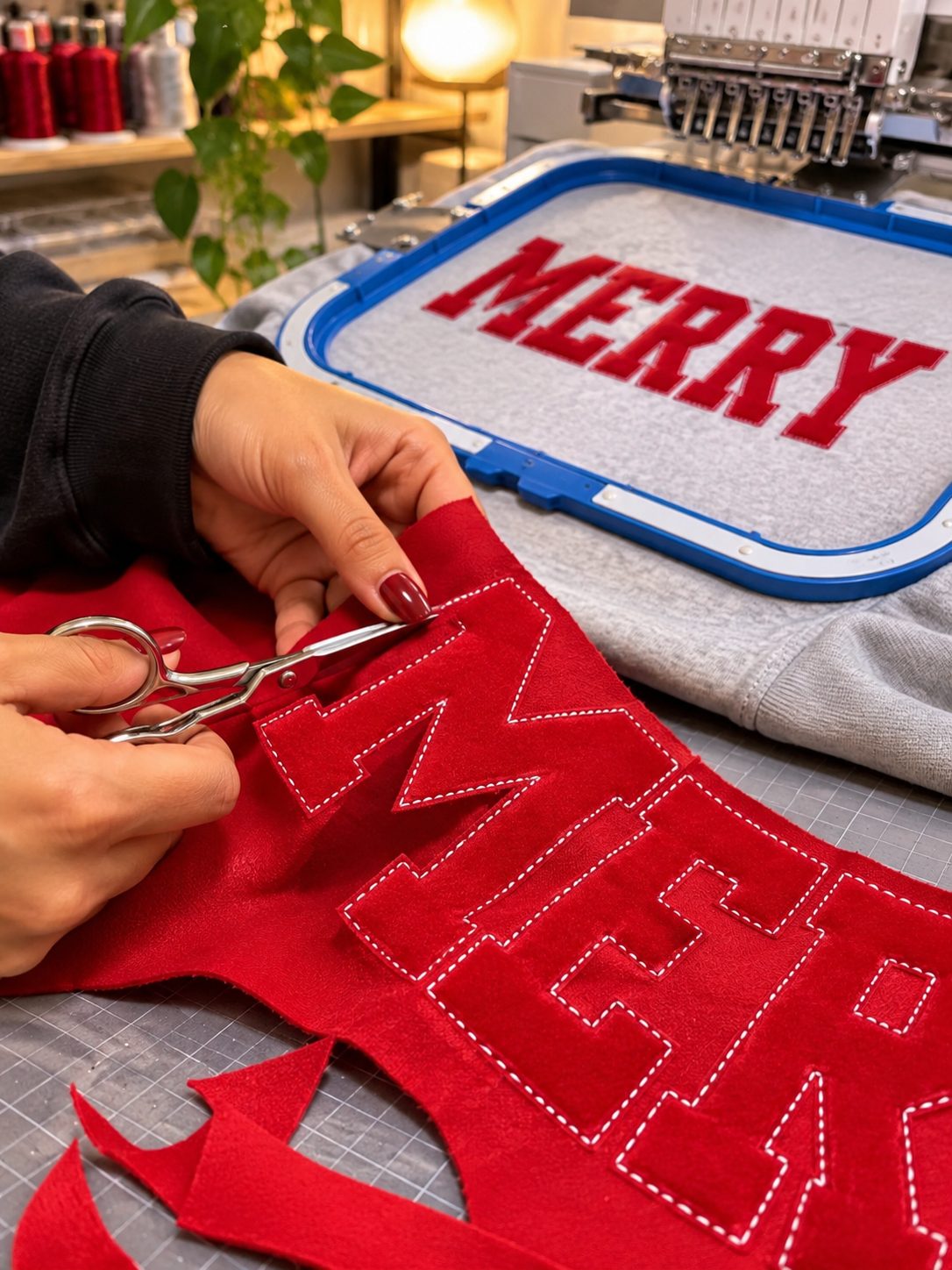
If you have cut large appliqué letters for sweatshirts, jackets, or team shirts, you already know the trim takes time. The letter still has to be a height the font was built for. That choice is in the embroidery font size guide. Scissors around every letter need a steady hand. A small slip can nick the garment or leave a lump under the satin. A laser can cut fabric to a digital outline instead, so repeated shapes stay closer to the same contour.
This guide covers how laser cutting fits machine embroidery appliqué, where it helps, where it does not, and what a small embroidery business should weigh before buying one.
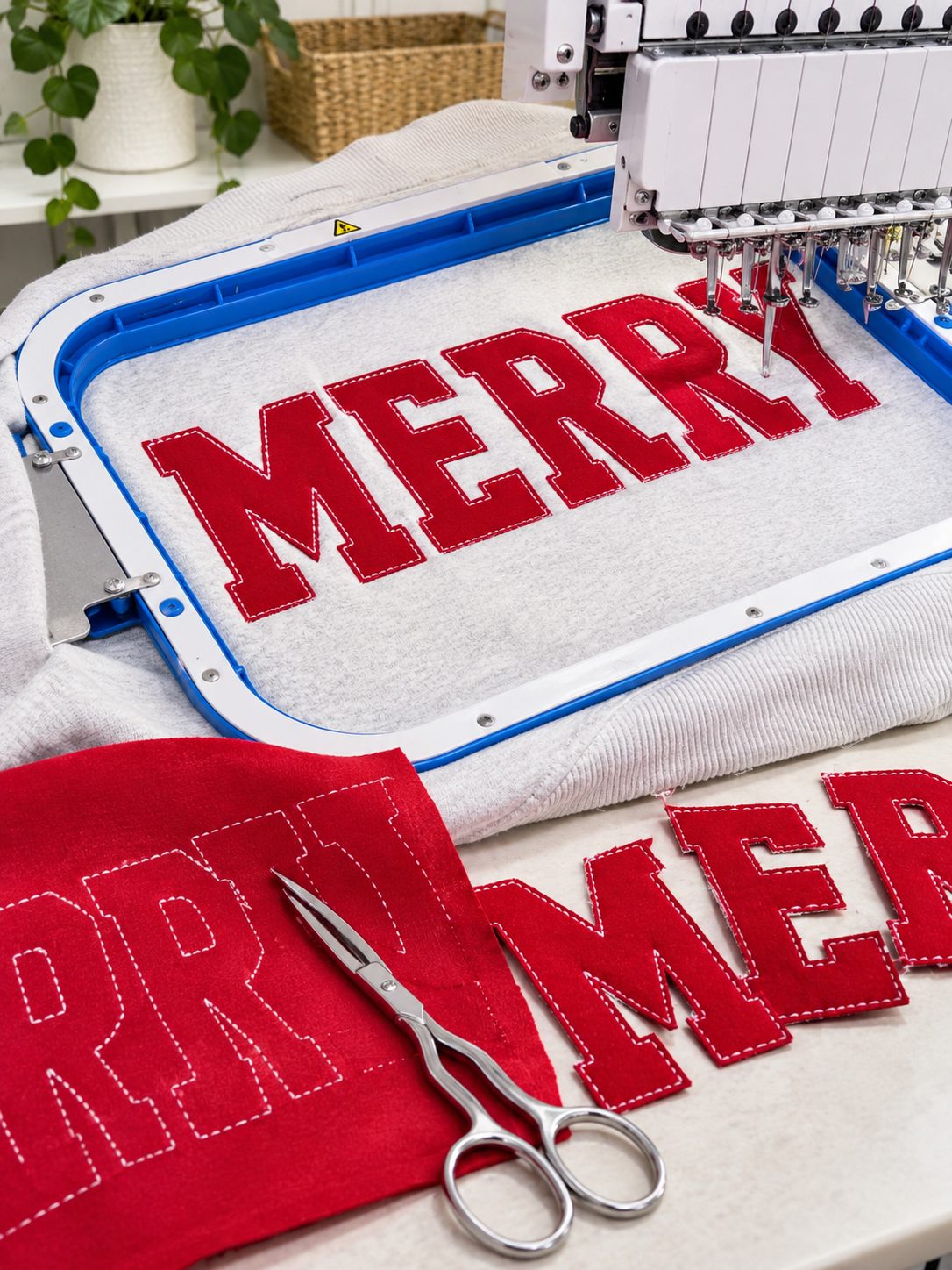
Manual appliqué trimming. Cut close to the tack-down stitch, without cutting the garment or the stitches.
1. What is laser cutting in machine embroidery?
Laser cutting uses a focused beam to separate material along a digitally defined shape. In embroidery it can prepare appliqué pieces, cut patches, open decorative shapes, and produce lettering with complex outlines.
Unlike scissors, the beam follows the same contour every time. That matters when a design has many letters, tight corners, or the same name on a run of garments. A sweatshirt that says MERCURY in large varsity letters needs an accurate fabric piece for every character. Trimming each one by hand adds up. A digital cut is another way to prepare those shapes. The same idea shows up in emblem, patch, and label production.
How it relates to appliqué embroidery
Machine appliqué attaches a piece of fabric to a base and covers the edge with stitches. A typical letter still follows the same stages. The color-stop order is in how to stitch an applique font.
Placement. An outline shows where the fabric belongs.
Fabric positioning. The appliqué material goes over that area.
Securing. Stitches hold the material in place.
Trimming. Extra fabric comes off where the design requires it.
Finishing. Satin, or another edge stitch, covers the raw boundary.
A laser can help at the fabric-preparation or cutting stage, depending on the machine. It does not replace embroidery. The embroidery machine still stitches the design, holds the fabric, and makes the finished letter.
2. Why are embroiderers interested in laser-cut appliqué?
The draw is less repetitive hand work, with shapes that match from one piece to the next. A few custom shirts a week may not need it. Twenty-five school sweatshirts, each with a large name, is a different job. Every garment needs the same careful pieces, and the scissors become a large part of the day.
The machine still stitches the letter. Cutting, by scissors or by laser, only prepares the fabric.
More consistent lettering shapes
Hand-cut letters drift. Curves, corners, narrow gaps, and the holes inside A, B, D, O, P, and R are the usual trouble. A digital contour can repeat the same outline. That helps with varsity and collegiate lettering, large block fonts, team names, school uniforms, custom sweatshirts, and repeated monograms. Customers expect every letter in a word to share the same weight and a clean edge.
Less dependence on repetitive trimming
Six large letters can mean six separate trims. Across many similar orders, that work is a real share of the job. Automated cutting can take some of it off the bench. It does not remove fabric prep, file setup, stitching, inspection, or the satin finish.
More room for complex shapes
Unusual outlines and detailed emblems are hard to repeat with scissors. Laser systems are built for irregular contours, which is why patch makers already use them. For a lettering shop, that can mean more elaborate appliqué without every piece depending on one person’s cutting hand.
3. Laser cutting vs. traditional appliqué trimming
Both belong in machine embroidery. Volume, shape, equipment, and fabric decide which one fits.
Consideration
Manual trimming
Laser-assisted cutting
Initial investment
Usually lower
Generally higher
Production consistency
Depends on operator precision
Can provide repeatable contours
Repetitive work
Requires manual effort
Can reduce certain repetitive tasks
Complex outlines
Can require additional attention
Suitable for digitally defined contours
Small custom orders
Often practical
Depends on workflow and setup
Material compatibility
Broad, depending on cutting tools
Depends on material and system
Production requirements
Manual finishing remains important
Additional equipment and oversight
A hobbyist, or a shop that finishes a few custom garments a week, will often stay with scissors. A shop that repeats the same large appliqué can get more from automation. The question is not only whether the laser is faster. It is whether the whole process, including the cost of the machine, pays for itself.
4. Which embroidery products can benefit?
Laser-assisted cutting is most useful when the outline has to match, and the same design comes back.
Varsity and collegiate lettering
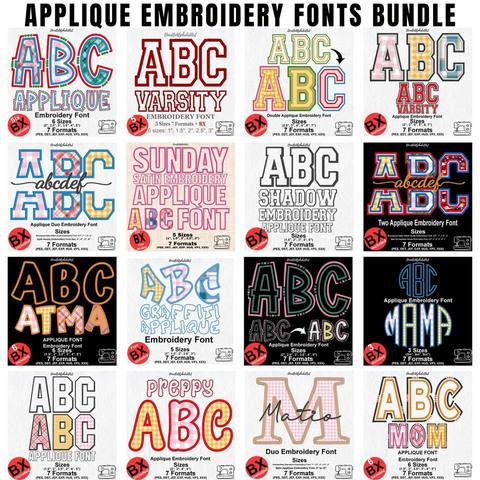
Bold block letters with thick outlines and a large fabric fill are the clearest case. A university name across a chest has to keep its proportions and spacing on every shirt. Consistent cutting helps. The same applies to school spirit wear, college sweatshirts, team apparel, club uniforms, and personalized jackets. Applique embroidery fonts built for those letters already include the placement, tack-down, and satin stops.
Large appliqué names
A long name is many separate shapes. A coordinated cut helps the same lettering style land the same way on the next garment. If the word is longer than the hoop, split it first. That is covered in stitching big words on a small hoop. Letter spacing still has to be set in the design. The checks are in the embroidery letter spacing guide.
Embroidered patches and emblems
Patches follow a logo or an odd outline. Laser cutting is already used in emblem work because those contours are hard to repeat by hand. If custom patches are a regular product, the cutter is worth pricing as part of that workflow, not as a gadget beside the embroidery machine.
Decorative appliqué
The same idea can apply to children’s clothing, quilts, baby blankets, cushions, accessories, and seasonal garments. The gain depends on the shape, the fabric, and how many times you will cut it.
5. Does laser cutting improve appliqué lettering?
It can make the fabric pieces more consistent. It does not, by itself, make a better embroidery design.
Digitizing quality
A clean cut cannot rescue a weak file. Placement, tack-down, edge coverage, and the proportions of the letter still have to agree. Narrow sections, inside openings, and sharp corners need to be built for appliqué, not borrowed from a print font. If you type the letters in Embrilliance, start with how to install a BX font and the Embrilliance Essentials beginner guide. The stitch file still has to match the machine. Use which embroidery file your machine uses before you send a run.
Fabric
Some synthetics seal at the edge. Others discolor, scorch, or leave a hard rim. Cotton and polyester do not behave the same way under a beam. Test the cloth you actually sell, instead of assuming the sample on the brochure is your fabric.
Embroidery finishing
Even identical pieces still need accurate placement and a satin border that covers the raw edge. An uneven border or a cramped word will show, no matter how the fabric was cut. Treat cutting and stitching as one process.
6. Is laser cutting suitable for every fabric?
No. Heat is the limit. Certain synthetics can leave a sealed edge. Other cloth can discolor or burn. Cotton, polyester, nylon, felt, and blends are not interchangeable. Sometimes a blade, or scissors, is the better cut. For an embroidery business, laser cutting is a specialized option, not a replacement for every trim. Material fit and machine safety belong with the manufacturer’s instructions and a trained operator, including ventilation and the guards the system requires.
7. What are the limitations?
Initial investment
The cutter is a second machine, plus software, space, maintenance, and the safety setup around it. Buying it because it is talked about does not make it a good purchase.
Learning and workflow
The shapes have to match the embroidery files you already use. File prep, material choice, and inspection all move. You can save time at the scissors and spend it somewhere else. The machine formats in the download are listed on PES, DST, JEF, and the other stitch formats.
Materials and upkeep
Not every textile belongs on every laser. A shop that switches fabrics often should treat that as a real constraint. The machine also needs supervision, maintenance, a suitable room, protective measures, and professionally managed ventilation. Those are part of the cost, not extras.
8. Is it worth it for a small embroidery business?
It depends on the orders you actually take.
When it may be worth considering
Large varsity appliqué lettering.
Repeated school and sports uniforms.
Custom patches and emblems.
Large personalized sweatshirt designs.
Several garments with the same lettering.
Complex fabric shapes that have to match.
When scissors are enough
Small monograms. A short initial is usually faster with scissors. The typing steps for a connected heart script are in the Heart Monogram Satin Script guide.
Occasional gifts.
Simple appliqué.
Low-volume custom orders.
Outlines that are straightforward to trim.
No shop is required to automate cutting. Buy equipment that removes a problem you already have.
A practical way to judge the return
Count the time you already spend cutting. Suppose a shop finishes 40 appliqué garments a month, and a large share of each job is the trim. Shortening that step can free time. Time is not profit by itself. Also count the purchase and the running cost, how many of those orders truly need a repeated contour, training, maintenance, and whether the extra capacity can be sold. The goal is a better month, not an easier afternoon.
9. Where appliqué lettering is heading
Design files, the embroidery machine, and textile cutting are moving closer together. For a long time the bench was a machine, scissors, stabilizer, digitizing software, and hand finishing. Shops that live on varsity names, school apparel, uniforms, and personalized sweatshirts repeat the same sizes. Height still comes from the font, not from shrinking a large design. That is the point of the letter height guide. Automation can speed one stage. It does not replace a sound letter, the right fabric, or a file built for appliqué.
10. Choosing an embroidery font for these projects
The font matters as much as the cutter. A satin alphabet and an appliqué alphabet are not the same file. For large fabric letters, look at four things.
Letter structure. Bold, clear shapes read on sweatshirts, jackets, and team wear.
Internal spaces. A, B, D, O, P, and R need room for the hole and the border.
Letter spacing. A long chest word has to stay balanced. Set that before you cut a stack of pieces.
Stitching and finishing. The file should be digitized for fabric placement and edge coverage, not only for a screen preview.
Laser cutting can give an appliqué shop repeatable fabric shapes and less scissor time, especially on varsity lettering, team wear, and patches. It is not a universal upgrade. Cost, fabric, workflow, maintenance, and safety all sit on the same side of the decision as the speed.
Smaller shops with occasional appliqué can keep trimming by hand and still finish clean letters. The method should match the volume, the designs, and the budget. Either way, professional appliqué still starts with lettering that was digitized for fabric and a satin edge. Very small names are a different job. Those checks are in how to embroider small letters.
No. Laser cutting can prepare or cut appliqué fabric. The embroidery machine still stitches the design, secures the fabric, and covers the edge.
Is laser cutting suitable for every fabric?
No. Cotton, polyester, nylon, felt, and blends do not react the same way to heat. Some synthetics seal cleanly. Others can discolor or scorch. Test the material and follow the equipment maker’s guidance.
Is laser cutting worth it for a small embroidery business?
It can be, when you regularly stitch large varsity names, repeated uniforms, patches, or complex shapes. Occasional gifts and simple letters are often faster and cheaper to trim by hand.
This shop stores one cookie to remember your choice. If you accept, it stores a random number so the studio can count unique and returning visitors, and Google Ads may measure the visit. Reject non-essential leaves both off. PayPal is loaded only when you pay, and rejecting optional cookies does not turn payment off.